Why the “bolts and brackets” of your body matter more than you think. THE HIDDEN HARDWARE OF YOUR BODY When you look at a well-built house, you see walls, floors, and the roof. But what really holds it together are the hidden components — the bolts, brackets, and fasteners inside the structure. You don’t notice …

Why the “bolts and brackets” of your body matter more than you think.
THE HIDDEN HARDWARE OF YOUR BODY
When you look at a well-built house, you see walls, floors, and the roof.
But what really holds it together are the hidden components — the bolts, brackets, and fasteners inside the structure.
You don’t notice them daily.
But if they weaken, doors sag, frames shift, and the whole structure feels less secure.
Grip strength is one of those hidden structural elements of your body.
It reflects the integrity of the system beneath the surface.
For the full framework, see The Big Picture: How All Five Systems Work Together.
WHY GRIP STRENGTH IS LIKE A STRUCTURAL INSPECTION
In construction, inspectors often check key load-bearing points to assess the condition of a building.
Grip strength works in a similar way — it’s a quick inspection point that gives insight into:
- overall strength
- muscle health
- nervous system efficiency
- functional capacity
It’s not just about your hands.
It’s a signal of how robust the whole structure is.
WHAT THE RESEARCH SHOWS
Large population studies have found grip strength to be one of the simplest physical measures linked with long-term health.
- A major international study in The Lancet identified grip strength as a strong predictor of overall mortality and cardiovascular health.
- Research published in the British Medical Journal linked lower grip strength with higher risk of functional decline.
- Studies across ageing populations show strong correlations between grip strength and independence.
Think of it like a stress test for the building — a simple measure that reveals deeper structural resilience.
THREE WAYS TO TEST YOUR “STRUCTURAL HARDWARE”
These tests are like checking the integrity of key support points in a renovation.
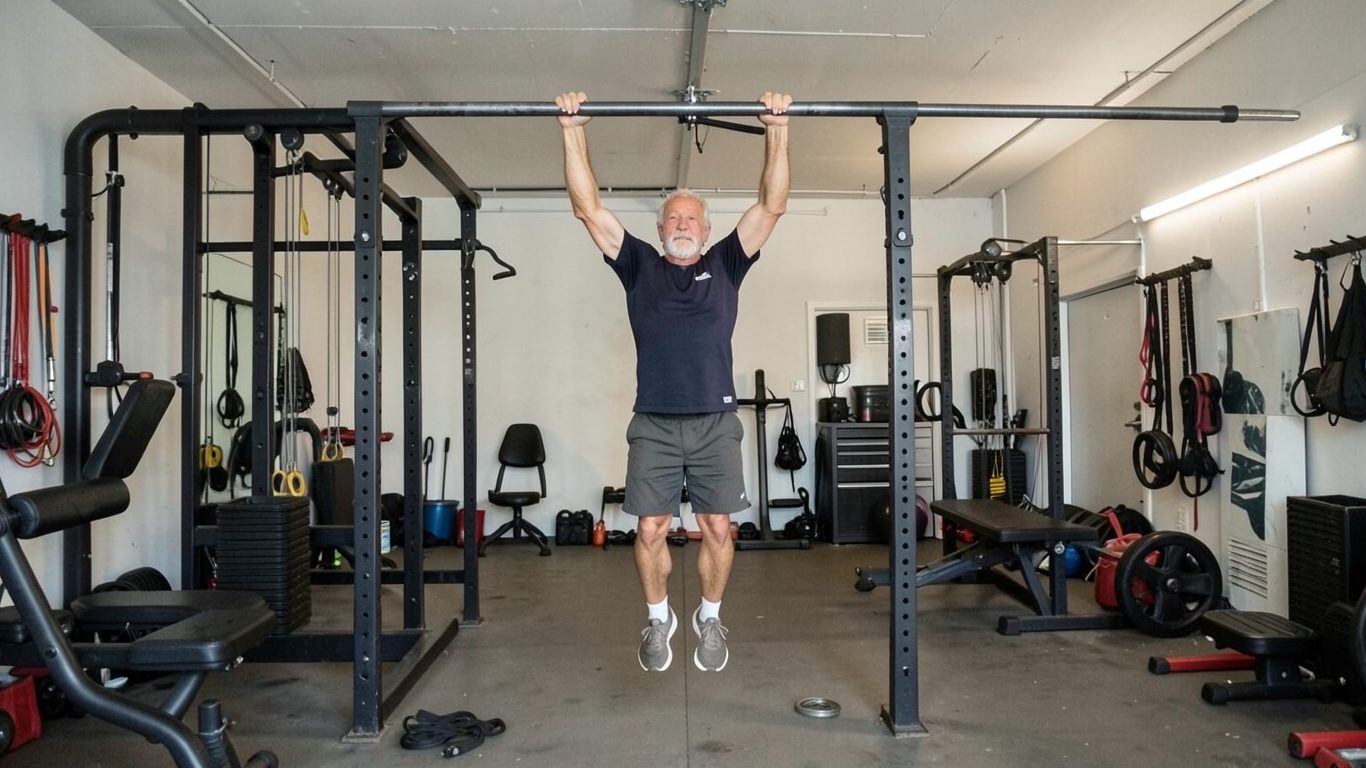
DEAD HANG TEST — THE LOAD TEST
Just as engineers test whether a beam can hold weight, the dead hang tests your body’s ability to support its own load.
How to do it
Hang from a bar with arms straight and time your hold.
HAND DYNAMOMETER — THE PRESSURE TEST
This measures maximum force — like checking how much torque a bolt can handle.
How to do it
Squeeze the device as hard as possible and record the best result.
FARMER’S CARRY HOLD — THE REAL-WORLD TEST
This simulates carrying building materials — practical strength rather than isolated force.
How to do it
Hold weights at your sides and time your hold.
For functional strength context, see Strength for Life.
HANG TIME BENCHMARKS FOR 50+
Think of these like building safety ratings — useful guides, not pass/fail scores.
Men 50–59
Excellent: 45–60+ seconds
Good: 30–45 seconds
Needs improvement: 15–30 seconds
Low: under 15 seconds
Men 60–69
Excellent: 30–45+ seconds
Good: 20–30 seconds
Needs improvement: 10–20 seconds
Low: under 10 seconds
70+
Excellent: 20–30+ seconds
Good: 15–20 seconds
Needs improvement: 8–15 seconds
Low: under 8 seconds
These simply show how well your “support hardware” is holding up.
WHAT LOW GRIP STRENGTH CAN SIGNAL
In a house, loose fixings don’t mean collapse — but they suggest wear and tear.
Similarly, low grip strength can reflect:
- reduced muscle mass
- inactivity
- fatigue
- reduced resilience
The Role of Muscle in Healthspan.
The encouraging part: these “fasteners” can be tightened with training.
HOW TO REINFORCE YOUR STRUCTURE
Think of these as strengthening the brackets and joints that keep everything secure.
Carrying exercises — load the structure
Farmer’s carries reinforce functional strength.
Hanging — test and strengthen support points
Dead hangs improve endurance and joint resilience.
Resistance training — upgrade the framework
Pulling movements naturally strengthen grip.
Safe Strength Training for Men Over 50.
Daily use — ongoing maintenance
Simple tasks like carrying bags are everyday structural checks.
Consistency keeps the system strong.
WHY THIS MATTERS FOR LONG-TERM INDEPENDENCE
A house with solid fixings stays functional longer.
A body with strong grip tends to maintain:
- mobility
- balance
- confidence
- independence
Grip strength isn’t just a detail — it’s part of the structural integrity that supports everything else.
RENOVATION DAD PERSPECTIVE
When renovating, you don’t just paint the walls — you make sure the frame behind them is sound.
Grip strength is part of that hidden frame.
You don’t need to obsess over it.
Just check it occasionally and keep it strong.
RENOVATION DAD BOTTOM LINE
Grip strength is one of the simplest ways to gauge how solid your physical “build” is.
It’s not about squeezing harder.
It’s about maintaining the structural integrity that supports your strength, movement, and independence.
Check the hardware.
Reinforce where needed.
Keep the structure solid.
Stay strong. Stay capable. Stay independent.
RECOMMENDED RELATED POSTS
Strength for Life — build total strength
The Role of Muscle in Healthspan — understand muscle’s role
Balance, Falls & Confidence — stability and safety
Longevity Training — long-term plan