How to measure what really matters for long-term strength, fitness and independence THINK OF THIS AS YOUR BODY’S BUILDING INSPECTION When you buy or renovate a house, you don’t judge it by the paintwork. You check whether the structure underneath is sound. You look at the foundations.You check the load-bearing walls.You make sure the building …

How to measure what really matters for long-term strength, fitness and independence
THINK OF THIS AS YOUR BODY’S BUILDING INSPECTION
When you buy or renovate a house, you don’t judge it by the paintwork.
You check whether the structure underneath is sound.
You look at the foundations.
You check the load-bearing walls.
You make sure the building is level.
You inspect the systems that keep everything working.
Your body deserves the same approach.
You don’t need to obsess over numbers, chase personal bests or turn every workout into a test.
But you should have some idea of how well your body is actually functioning.
Because looking fit and being capable are not the same thing.
The right physical metrics can tell you whether your body is strong enough, stable enough and fit enough to keep supporting the life you want to live.
For the bigger picture behind this approach, see The Big Picture: How All Five Systems Work Together.
WHY MEASURING MATTERS
Most people train without ever checking whether they are improving the things that actually matter.
They might know their bodyweight.
They might know how much they can bench press.
They might know how many steps they take.
But none of those numbers tells the whole story.
Useful metrics give you:
- direction
- a starting point
- evidence of progress
- an early indication of weak areas
- a reason to adjust your training when needed
The important thing is not to treat the result as a judgment.
A poor score does not mean you have failed.
It simply tells you where the renovation needs attention.
The goal is not perfection.
The goal is capability.
THE FIVE CHECKS THAT MATTER MOST
You could measure dozens of things.
Most people do not need to.
For men over 50, I would rather know how well you perform across a handful of basic physical qualities that affect everyday life.
These five checks give you a much more useful picture.
1. GRIP STRENGTH — CAN YOU HOLD ON?
Grip strength is one of the simplest indicators of physical capacity.
It matters because your hands are involved in almost everything:
- carrying shopping
- lifting objects
- opening jars
- gardening
- climbing
- training
- holding onto something if you stumble
Grip also reflects more than just hand strength. It is strongly linked with overall muscular function.
A simple way to test it
The most accurate option is a hand-grip dynamometer.
If you do not have one, you can also use practical measures such as:
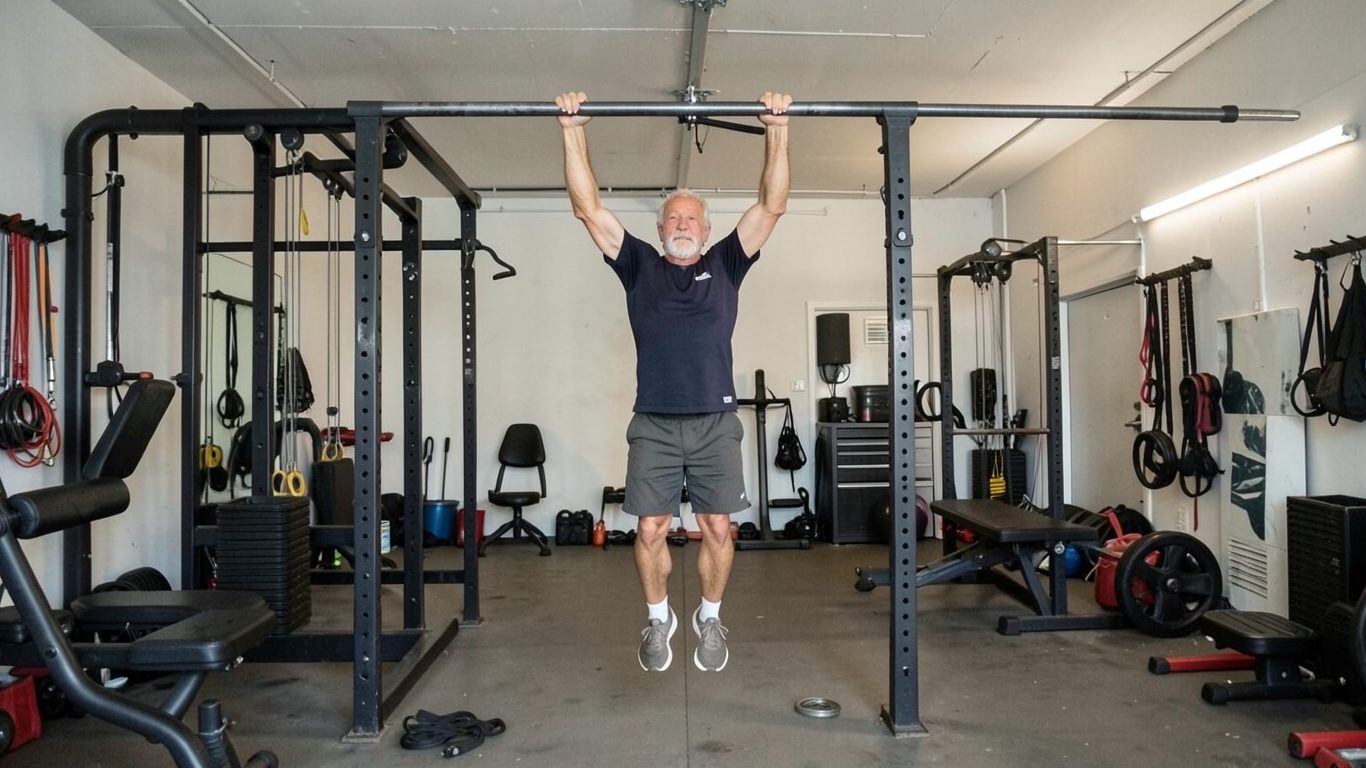
- a dead hang from a bar
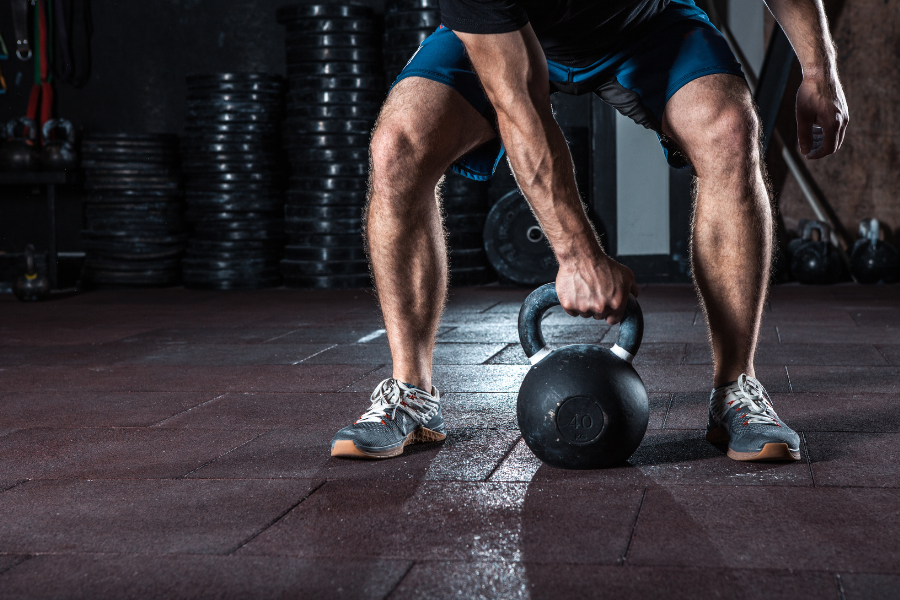
- heavy farmer carries
- timed suitcase carries
You do not need to chase elite numbers.
You want to see whether your grip is improving and whether it is strong enough for the demands you place on your body.
Read the full guide: Grip Strength After 50
2. LOWER-BODY STRENGTH — CAN YOU GET YOURSELF UP?
Your legs are the load-bearing structure of the body.
If lower-body strength declines, everyday tasks start becoming harder surprisingly quickly.
Getting out of a chair.
Climbing stairs.
Getting up from the floor.
Walking uphill.
Carrying something heavy.
All of these depend on leg strength.
A simple way to test it
One of the easiest options is the 30-Second Chair Stand Test.
Sit in a standard chair with your arms crossed.
Stand fully upright and sit back down as many times as possible in 30 seconds.
It is simple, requires almost no equipment and gives you a useful measure of lower-body function.
Even more important than the number itself is whether your performance improves over time.
You should also notice real-life changes:
- getting up more easily
- climbing stairs with less effort
- feeling stronger on hills
- being more confident getting down to and up from the floor
Strength should make life easier.
That is the point.
3. BALANCE — CAN YOU CONTROL YOUR BODY?
Balance is easy to ignore until you start losing it.
Then it becomes extremely important.
Good balance helps you:
- move confidently
- change direction
- step over obstacles
- recover from slips
- reduce fall risk
Think of balance as part of the body’s stability system.
Strength gives you force.
Balance helps you control it.
A simple way to test it
Try a single-leg stand.
Stand near a wall or something stable.
Lift one foot off the floor and time how long you can remain steady.
Test both sides.
You are not looking for circus-level balance.
You are looking for control.
Watch for:
- large differences between sides
- excessive wobbling
- needing to put your foot down almost immediately
- a decline compared with previous tests
Read: Balance, Falls & Confidence
4. MOBILITY — CAN YOU USE THE MOVEMENT YOU HAVE?
Mobility is not about becoming flexible for the sake of it.
It is about maintaining enough movement to use your body properly.
You need mobility to:
- reach overhead
- rotate
- squat
- kneel
- get down to the floor
- get back up again
This is where many people make a mistake.
They assume that feeling stiff is just part of getting older.
Some change is normal.
Losing large amounts of usable movement does not have to be.
A simple way to test it
One useful whole-body test is the Sitting-Rising Test.
Can you lower yourself to the floor and get back up with minimal support?
You can also look at simple movement tasks such as:
- reaching both arms overhead comfortably
- rotating your upper body in both directions
- squatting to a comfortable depth
- getting down to the floor without worrying about how you will get back up
Mobility should support everyday movement.
That is more useful than being able to touch your toes.
See: Mobility After 50
5. ENDURANCE — CAN YOU KEEP GOING?
Strength might help you lift something.
Endurance helps you keep living.
It supports:
- walking
- hiking
- gardening
- travel
- playing with children or grandchildren
- climbing stairs
- recovering between physical tasks
Cardiovascular fitness is one of the major parts of long-term capability.
You do not need to become a runner.
You do need enough aerobic capacity to move through life without constantly feeling exhausted.
A simple way to test it
A very practical option is the 6-Minute Walk Test.
Walk as far as you comfortably can in six minutes on a flat surface.
Record the distance.
Repeat it every few months under similar conditions.
You can also track:
- walking pace
- how breathless you feel
- heart-rate response
- how quickly you recover afterwards
The point is not to turn walking into a race.
It is to see whether your engine is getting stronger.
See: Walking, Rucking & Low-Impact Cardio
WHAT THESE TESTS TELL YOU TOGETHER
Individually, each test only tells you part of the story.
Together, they give you a much better picture of your physical capability.
You might have excellent endurance but poor strength.
You might be strong but stiff.
You might move well but struggle with balance.
You might perform reasonably in every area without being exceptional in any of them.
That is often a very good place to be.
The goal is not to become highly specialised.
It is to build a body that remains broadly capable.
Strong enough.
Mobile enough.
Fit enough.
Stable enough.
Useful enough.
YOU DO NOT NEED TO BE GREAT AT EVERYTHING
This matters.
A lot of fitness culture encourages comparison.
Faster.
Stronger.
Leaner.
More extreme.
That is not what these tests are for.
You are not trying to win an imaginary leaderboard.
You are trying to identify weak links.
If four areas are solid and one is clearly lagging behind, that gives you useful information.
That is where you put some extra work.
Renovation works the same way.
You reinforce what needs attention instead of rebuilding the entire house.
HOW OFTEN SHOULD YOU TEST?
You do not need to test every week.
In most cases, every 8 to 12 weeks is plenty.
That gives your training enough time to produce meaningful change.
It also stops testing from becoming another source of pressure.
Use the numbers to guide your training.
Then get back to training.
WHAT REAL PROGRESS LOOKS LIKE
Progress after 50 is not always dramatic.
Sometimes it is.
More often, it looks like:
- getting out of a chair without thinking about it
- carrying heavier shopping
- walking further without fatigue
- climbing stairs more comfortably
- recovering faster after exercise
- feeling steadier on uneven ground
- getting down to the floor and back up again
- having more confidence in what your body can do
Those improvements matter.
They are signs that your physical reserve is increasing.
For more on this, see What Strength Progress Looks Like After 50.
WHY THESE METRICS MATTER FOR LONG-TERM INDEPENDENCE
The real reason to measure these things has very little to do with fitness for fitness’s sake.
They influence whether you can continue to:
- live independently
- travel
- walk long distances
- carry things
- get yourself off the floor
- climb stairs
- remain active
- take on new challenges
That is a much bigger prize than simply looking fitter.
You are building physical capacity you can draw on later.
Think of it as maintaining a reserve.
The stronger that reserve is, the more room you have when life becomes demanding.
TAKE THE RENOVATING DAD 55+ BODY MOT
If you want a clearer picture of where you currently stand, take the Renovating Dad 50+ MOT!
It looks at key areas including:
- lower-body strength
- balance
- mobility
- cardiovascular fitness
- body composition
You complete the tests, enter your results and receive a score showing where your current strengths and weak points lie.
It is not about passing or failing.
It gives you a starting point.
Take the free 50+ MOT→
THE RENOVATING DAD APPROACH
You do not need endless data.
You need a few useful indicators.
Measure what matters.
Identify the weak links.
Train them.
Retest.
Repeat.
That is how you build a body that remains useful for decades.
RENOVATING DAD BOTTOM LINE
Do not judge your body by how it looks.
Inspect the structure.
Can you grip?
Can you stand?
Can you balance?
Can you move?
Can you keep going?
Those questions tell you far more about long-term capability than a number on a bathroom scale.
Check the structure.
Reinforce what needs work.
Then keep building.
Stay strong. Stay capable. Keep doing the things that matter.
WHERE TO GO NEXT
Grip Strength After 50 — understand and test your grip
Strength for Life — build strength that carries over into everyday life
Longevity Training– What actually keeps you independent as you age
Muscle & Healthspan – Why Strength is Your Greatest Asset for Longevity
The Weekly Routine That Keeps You Fit for Life — turn the principles into a practical week
The Big Picture: How All Five Systems Work Together — see how strength, movement, cardio, recovery and health fit together
Take the 50+ MOT — find your current starting point