Most men don’t think of stress as a fitness issue. They think of it as part of work, part of responsibility, part of life. So they tolerate it. They push through. They keep going. And over time, that constant background pressure starts to show up — not just in mood, but in the body. Tight …

Most men don’t think of stress as a fitness issue.
They think of it as part of work, part of responsibility, part of life.
So they tolerate it.
They push through.
They keep going.
And over time, that constant background pressure starts to show up — not just in mood, but in the body.
Tight shoulders.
Poor sleep.
Lingering aches.
Low energy.
Here’s the Renovating Dad truth:
Calm is not a personality trait. It’s a physical skill.
And after 50, it becomes one of the most important forms of strength you can rebuild.
Stress Is a Body Load, Not Just a Mental One
Stress isn’t only about worry or emotion.
It’s a full-body state.
When stress is high:
- Muscles stay tense
- Breathing becomes shallow
- Recovery slows
- Pain sensitivity increases
The body stays slightly braced — even at rest.
That guarded state makes:
- Mobility feel restricted
- Strength feel harder
- Balance less reliable
Which is why stress management sits alongside mobility after 55, safe strength training, and sleep & recovery — not separate from them.
Why Men Often Miss the Stress–Fitness Connection
Many men grew up with a simple rule:
“Get on with it.”
That mindset builds resilience.
It also hides warning signs.
Men often don’t notice stress until it shows up as:
- Constant stiffness
- Irritability
- Loss of enjoyment
- Training that stops working
These patterns overlap closely with why men over 50 feel stiff, tired, and slower.
A while back this surfaced in me, what I thought was a groin stain was in fact built up stress and tension which had grown over the years. Which I had just pushed to the back of my mind.
Finally with a couple of family issues, it tipped over the edge. Now, I have dealt with it but it is another area of maintenance that needs attention.
Calm Is the Foundation of Recovery
A calm nervous system is a recovering nervous system.
When calm improves:
- Sleep deepens
- Muscles relax more fully
- Reaction time improves
- Pain reduces
That’s why stress reduction isn’t optional for longevity training that keeps you independent as you age.
It’s foundational.
How Movement Reduces Stress (Without Trying)
You don’t need meditation apps to calm the body. Though they are helpful.
You need the right kind of movement.
Gentle, rhythmic movement:
- Lowers stress hormones
- Improves breathing patterns
- Signals safety to the nervous system
That’s why walking, rucking, and low-impact cardio are so effective.
They calm and condition at the same time.
Strength Training and Calm Can Coexist
Strength training doesn’t need to be aggressive.
When done properly:
- Controlled reps
- Moderate loads
- Good breathing
Strength sessions can reduce stress.
This approach is central to safe strength training for men over 50.
If training leaves you wired or irritable, something needs adjusting.
The Role of Breathing (Without Making It Weird)
Breathing affects the nervous system directly.
Slow, controlled breathing:
- Reduces muscle tension
- Improves heart rhythm
- Increases body awareness
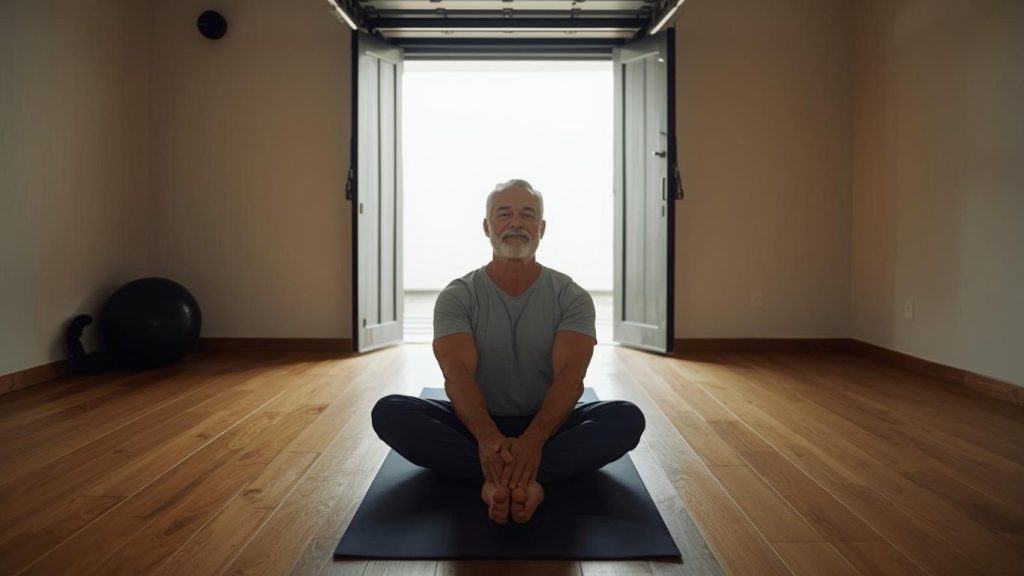
Simply find a quiet space for 5-10 minutes, sit or lie down. Close your eyes and just breath gently in through your nose and out from your mouth. Try not to think of anything, it’s harder than you think to start with.
These small changes improve calm without adding another task.
How Poor Calm Affects Balance and Confidence
Stress narrows attention.
It makes movement cautious and reactive.
That matters for:
- Stepping quickly
- Recovering from slips
- Moving confidently in busy environments
Which is why calm links directly to balance, falls & confidence.
A calm body reacts better.
Simple Ways to Build Calm Into Daily Life
You don’t need to retreat from life to reduce stress.
You need consistency.
A few Renovating Dad basics:
- Walk outdoors daily if possible
- Finish workouts feeling settled
- Reduce evening stimulation
- Prioritise sleep timing
None of this is dramatic.
All of it compounds.
Calm Supports Strength for Life
When the body feels safe:
- Movement becomes smoother
- Strength feels more available
- Confidence returns
That confidence supports the deeper purpose discussed in strength for life: staying capable for your kids and grandchildren.
Calm keeps you involved.
The Renovating Dad View of Stress and Calm
You don’t strengthen a house by keeping it under constant strain.
You relieve pressure.
You improve flow.
You allow it to settle.
Calm does the same for your body.
Where This Fits in Your Renovation
This article explained how mental load shows up physically.
Your Next Step
The Tension You Can’t Stretch Away — how stress lives in the body
Sleep & Recovery — the reset mechanism
Walking, Rucking & Low Impact Cardio — daily stress regulation
Renovation Dad Bottom Line
Calm isn’t a personality trait — it’s a skill.
Because real strength isn’t always about effort.
Sometimes it’s about learning how to let go.